
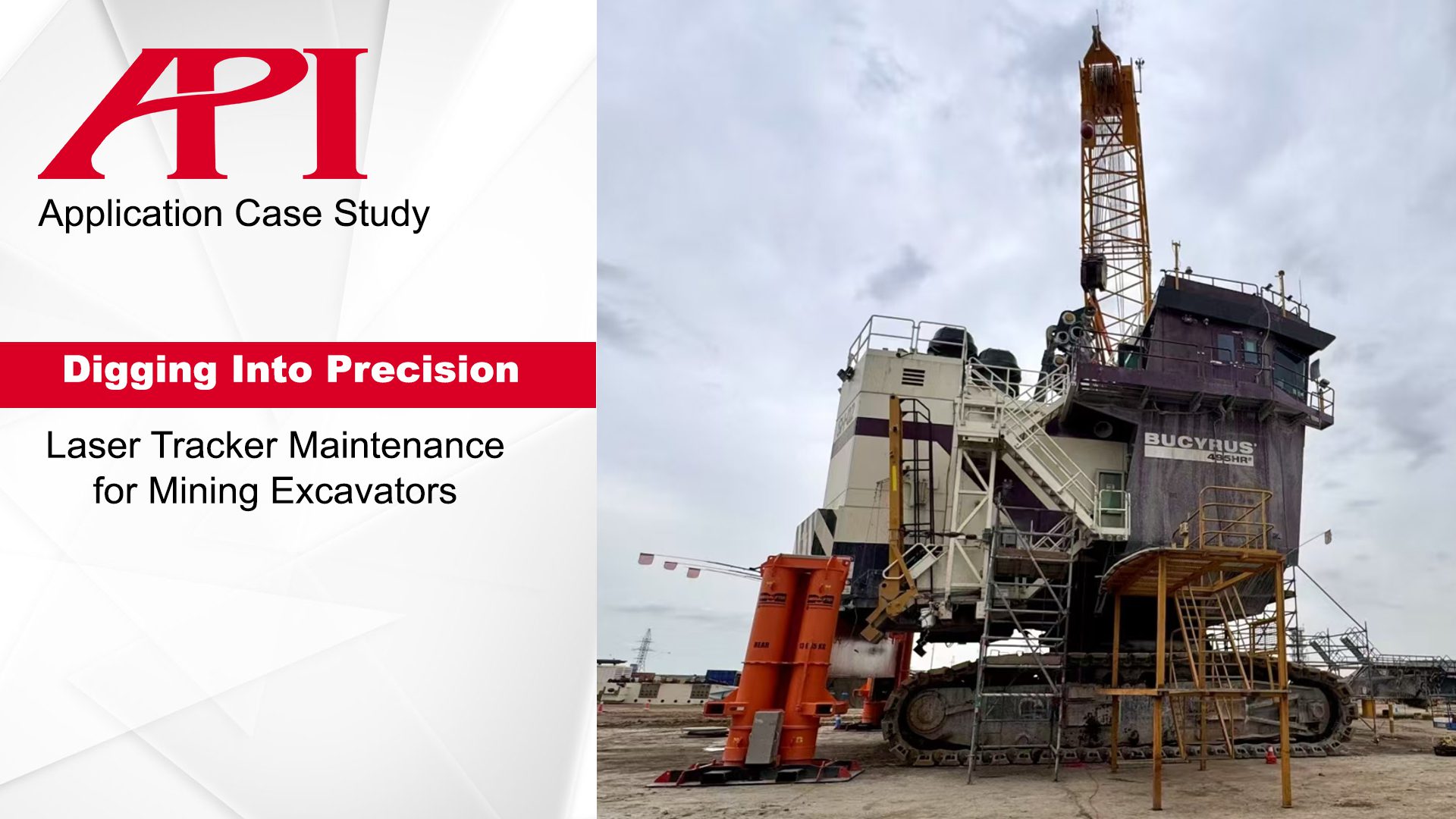
Overview of the Bucyrus 495HR Mining Excavator and Maintenance Requirements
The Bucyrus 495HR mining excavator is a critical large-scale asset in open-pit mining operations, where it performs demanding excavation and loading work. Because the machine runs under sustained heavy-duty conditions, its components are exposed to wear, deformation, and other forms of mechanical stress over time. These issues can reduce operating efficiency and may also introduce safety risks. As a result, accurate maintenance and repair are essential. Laser trackers have become an important measurement tool in this environment because they combine high precision with a large working volume, making them well suited to maintenance work on large mining equipment.

Working Principles and Characteristics of Laser Trackers
Laser trackers are based on laser interferometric distance measurement combined with angular measurement. Together, these systems allow the tracker to determine the three-dimensional coordinates of a target point in real time. The tracker emits a laser beam and continuously follows a target reflector with high accuracy, allowing it to capture measurement data quickly even in complex industrial environments. Key advantages include very high accuracy, large measurement range, and strong portability. These characteristics make laser trackers especially effective for on-site inspection and maintenance of large mining equipment.
Overview of API Laser Trackers
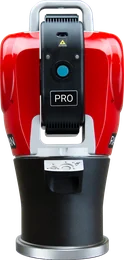
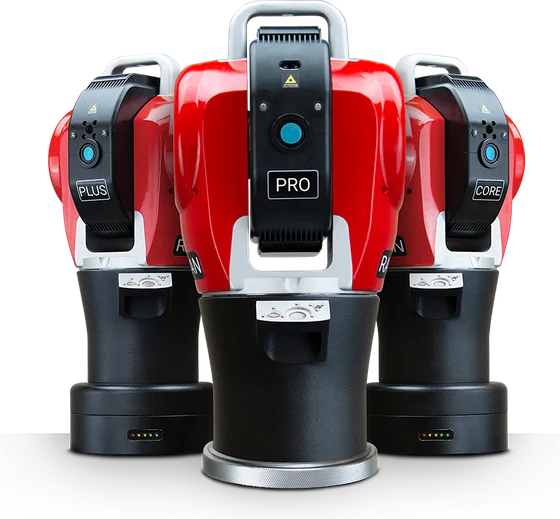
The Radian Pro is the flagship model in API’s Radian laser tracker family. It integrates both IFM interferometric laser measurement and ADM absolute distance measurement, providing traceable data for high-accuracy, high-standard measurement work. The Radian Pro can measure at up to 1000 Hz and performs effectively in both static and dynamic measurement modes. It also offers a very large measurement envelope, enabling precise measurement of parts and targets across ranges of up to 160 meters.
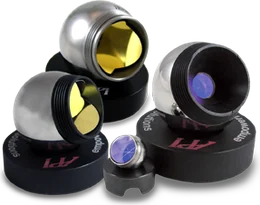
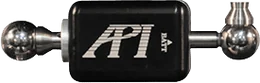
During measurement, the tracker locks onto a target sphere that contains a built-in prism. Once the sphere is positioned on the point to be measured, the tracker captures spatial data either manually or automatically. That measurement data is then transmitted to measurement software on a laptop for analysis and reporting.
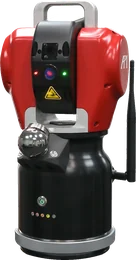
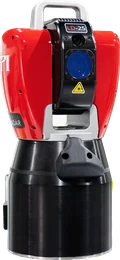
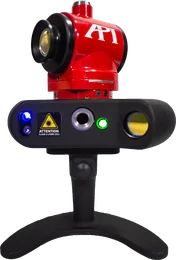
In addition to the flagship Radian Pro, API provides other tracker models to support a broader range of industries and applications. Radian Plus and Radian Core maintain high-accuracy measurement while adding battery power and wireless data transmission for fully wireless large-volume precision measurement. The iLT, introduced as a newer compact system, also supports fully wireless measurement while reducing the tracker body size by 50 percent compared with the Radian family. At only 4.9 kg, it is highly portable and well suited to mobile work, outdoor use, confined spaces, and multi-system integration environments.


Specific Applications of Laser Trackers Throughout the Maintenance Process
1. Dimensional Inspection of Structural Components
At the beginning of a maintenance project, structural components such as the crawler frame, boom, and stick must be inspected dimensionally. With a laser tracker, technicians can measure critical parameters such as length, width, height, bore size, and mounting-hole locations, then compare those values against the design drawings. This makes it possible to identify wear, distortion, or installation issues. For example, precise measurement of crawler frame mounting-hole positions helps ensure correct track installation and reduces the risk of abnormal machine travel caused by misalignment.
2. Equipment Installation and Alignment
After assembly work or component replacement, the machine must be installed and aligned accurately. A laser tracker can measure the coordinates of critical points such as the excavator swing center, boom pivot points, and stick pivot points so technicians can confirm the relative position of major components. In the case of boom installation, tracker data can be used to adjust installation angle and position until the assembly matches design intent. This helps maintain coordinated motion between machine components and improves both operating efficiency and stability.
3. Geometric Tolerance Inspection of Critical Components
Some components on a mining excavator, including hydraulic cylinders and gearboxes, must also be checked for geometric tolerances. Laser trackers can support inspection of cylindricity, flatness, straightness, and related geometric characteristics. For example, by evaluating the cylindricity of a hydraulic cylinder barrel, maintenance personnel can determine whether long-term use has caused distortion. If that distortion exceeds the acceptable range, the part can be repaired or replaced before it causes additional performance issues.
4. Monitoring Machine Condition During Operation
Laser trackers can also be used during post-maintenance trial operation. By continuously measuring displacement, vibration, and related movement of critical machine components, technicians can evaluate operating condition and detect early signs of fault conditions. For example, if the swing platform shows abnormal increases in runout or oscillation during rotation, that may indicate a problem with the swing bearing and justify further inspection.

Field Measurement and Analysis
In one open-pit coal mining application, a Bucyrus 495HR mining excavator began showing reduced digging force and unstable working performance after a period of operation. Maintenance personnel carried out a full inspection using a laser tracker and found that the boom pivot position had shifted, causing the boom motion path to deviate from its intended geometry. Based on the tracker data, the maintenance team adjusted and recalibrated the boom pivot point to restore the correct installation position. After the repair, the excavator’s digging force and operating stability returned to normal, helping the site avoid downtime and production loss.

Conclusion
Throughout the maintenance process for the Bucyrus 495HR mining excavator, laser trackers provide clear advantages in dimensional inspection, installation and alignment, geometric tolerance verification, and post-repair condition monitoring. Their high accuracy and efficiency help improve maintenance quality, increase repair productivity, extend equipment service life, and support safer and more reliable mine operation. For mining operations that rely on large excavators, laser tracker technology offers a practical and effective solution for maintenance-driven performance improvement.